
Johnston County Projected Versus Actual Release
Oklahoma uses the term Projected Release Date, or PRD, for ODOC’s estimate of when an offender will be released. The Oklahoma Pardon and Parole Board glossary makes clear that PPB does not calculate the date. ODOC sentence administration does. The estimate can move as credits, programs, misconduct, sentence data, and legal restrictions change.
Actual release is the physical end of one custodian’s hold. The jail’s release timestamp, an ODOC custody event, or a receiving agency record establishes that event. A PRD does not prove that the person walked out, and it does not account by itself for another county, federal, or immigration detainer. Release from Johnston County custody may instead be a transfer to ODOC or another agency.
A pretrial detainee usually has no sentence-based projected release date. Bond may be posted, a court may enter an order, or a hold may prevent departure. Even when a court authorizes release, jail processing can produce a later physical release time.
Find Johnston County Projected Release Dates
First identify the correct custodian and sentence type. The Johnston County active roster lists current inmates by name and booking date but has no projected release field. ODOC’s search applies only after a person enters the Oklahoma state corrections system. Federal and immigration custody use separate systems. No single portal calculates every kind of release.
- Check the Johnston County court case for the judgment, sentence, credited jail time, bond action, and later orders. Obtain the filed document when a short docket entry is unclear.
- Call Johnston County Jail at (580) 371-2691 to ask whether the person is currently held and which agency controls the date.
- For a county-jail sentence, ask the jail records office for the release-calculation record and actual release entry. Do not apply ODOC class credits.
- For an ODOC sentence, search the ODOC Offender Lookup by ODOC number or exact name and open the matched profile.
- If a projected field appears, preserve its exact label and disclaimer. If it does not, use an authorized ODOC route rather than calculating a date.
- Confirm later custody through ODOC, the jail, VINE, or the receiving agency. A parole result alone is not the release event.
The ODOC Offender Information page says an inmate’s exact release date is confidential without legitimate need. The inmate receives a monthly days-remaining figure and may share it. A facility records officer or case manager can assist the inmate. People with an authorized role should use ODOC Victim Services or the applicable formal records path.
The complete Johnston County release-record search also explains how to connect a county release entry to the next system when a transfer has occurred.
Oklahoma Earned Credits and Release Dates
Oklahoma’s earned-credit framework appears in 57 O.S. § 138. Each earned credit represents one day of incarceration. Credits can be earned, forfeited, restored, or restricted under the statute and ODOC policy. They are not an automatic flat discount from the court’s sentence, and the public should not use the class table as a stand-alone calculator.
Under the current structure, Class Level 1 earns no monthly credits and Level 2 earns 22. For a person who has ever had one of the felonies listed in § 138(E), Level 3 earns 33 and Level 4 earns 44. For a person who has never had an enumerated felony, Level 3 earns 45 and Level 4 earns 60. Class placement depends on assignment, evaluation, time at lower levels, conduct, hygiene and living-area standards, and program participation. Other restrictions may control.
Start with ODOC’s sentence administration record and credited jail time. Then apply the governing restrictions and authorized credits. ODOC updates the projection as the person’s class and credits change. Misconduct can delay the estimate. Eligible achievements or a higher class may advance it. Consecutive or concurrent terms and later court orders may alter the baseline.
Note: A life sentence is not reduced by earned-credit deductions, though program activity may still be recorded for the paroling authority.
Johnston County 85 Percent Sentences
Oklahoma’s 85-percent rule is in 21 O.S. § 13.1. For offenses listed there, a person must serve at least 85 percent of the imposed sentence before becoming eligible for parole consideration and before earned credits may reduce service in the restricted way set by the statute. The rule does not apply to every felony.
Use the conviction statute and offense date. An arrest charge is not enough. Eighty-five percent is also not the physical release date because jail credit, multiple counts, consecutive terms, sentence changes, parole action, and detainers can still matter. ODOC sentence administration remains the source for the operative estimate.
General parole eligibility is separate and date-sensitive under 57 O.S. § 332.7. Older offenses can follow matrix rules. For offenses from July 1, 1998 through October 31, 2018, the general provision commonly begins at one-third of the sentence. For offenses on or after November 1, 2018, it commonly begins at one-fourth, subject to mandatory minimums, exclusions, violent-offense rules, and other provisions. Eligibility only opens a possible consideration point. It is neither a PRD nor a grant.
Why Johnston County Release Dates Change
A projection changes when the legal or administrative inputs change. Some events move the estimate. Others change what happens when one sentence ends. The source record should identify which event applies, and any new date should still be treated as projected until physical release occurs.
| Factor | Possible effect | Record to verify |
|---|---|---|
| Earned-credit class | Authorized credits may advance the estimate | ODOC sentence administration and class record |
| Misconduct | Credit loss or class change may delay it | ODOC disciplinary and sentence record |
| Jail-time credit | A correction may change the sentence baseline | Court order and ODOC calculation |
| Sentence modification | A later order may shorten, extend, or restructure the term | Filed Johnston County court order |
| Concurrent or consecutive terms | Aggregation changes the controlling calculation | Judgments and ODOC sentence record |
| Parole action | May create a conditional path to release | PPB result and later ODOC status |
| Detainer or hold | May cause transfer instead of community release | Holding and receiving agency records |
A favorable PPB action does not prove release on the meeting date. Some actions require more steps, including gubernatorial action. Likewise, reaching the end of one term can lead straight to another custodian if an active hold exists.
Johnston County Jail Release Computation
County-jail sentence calculations belong to Johnston County Jail and the sentencing court, not ODOC’s public PRD worksheet. Oklahoma law, including 57 O.S. § 65, addresses county-jail credits in specified circumstances. The judgment controls the term and credited time. Ask the jail for the release-calculation record and ask the Johnston County Court Clerk for the judgment and any later order.
The distinction matters because ODOC class-level credits cannot simply be copied onto a county sentence. A person may also be held pretrial rather than serving a final sentence. In that case, bond, court action, and other holds determine when release can occur. A docket entry that says bond posted or time served can explain authority, but the jail’s actual release entry supplies the custody timestamp.
Request narrow fields: the sentence source, credited jail time, calculation record, actual release date and time, release code, and receiving agency if transferred. If a code is abbreviated, ask for its official legend. Do not translate it by guesswork.
Johnston County PRD Access Limits
ODOC does not promise a public exact date for every current inmate. Its FAQ calls an exact release date confidential unless the requester has a legitimate need and says that inmates receive a monthly days-remaining figure. PPB’s glossary, meanwhile, defines PRD as an ODOC estimate that may rise or fall because of credits, programs, or misconduct. These statements control over any unofficial date claim.
The ODOC release-date FAQ shown below documents the confidentiality and tentative-date limits.
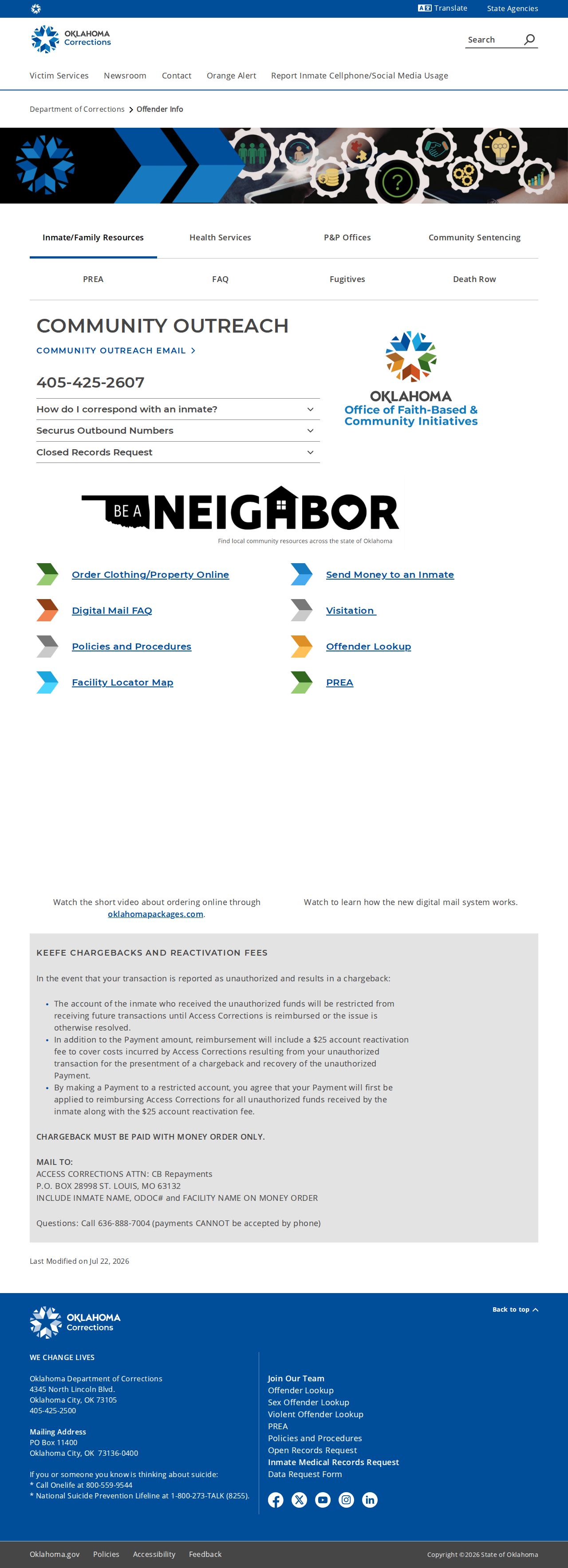
The screenshot supports the official access rule. It does not reveal or certify a date for a particular person.
ODOC’s Projected Release Date worksheet shows class-level projection structure, while OP-060211 Sentence Administration supplies the administrative framework. Neither should be used to reverse-engineer an exact date without the complete sentence record.
Note: Johnston County jail sentences require jail and court verification; ODOC’s worksheet governs a different corrections system.
Confirm Johnston County Actual Release
For Johnston County Jail, call the custody line and obtain the sheriff’s release entry. The records office is at 110 N. Capital Ave., Tishomingo, OK 73460, with posted records service Monday through Friday, 8:30 a.m. to 4:30 p.m. The jail line is (580) 371-2691, and the records line is (580) 371-2646. Request the release time, release or transfer code, and receiving agency rather than asking staff to certify that someone is free.
For ODOC custody, confirm the profile’s exact status and retrieval date. If parole was involved, pair the PPB result with the later ODOC status. A community-supervision entry means incarceration may have ended while legal supervision remains. A discharge entry concerns the ODOC obligation described by that record, not any new case elsewhere.
When the public profile does not display an exact PRD, do not substitute the sentence length shown in a court docket. A valid calculation can depend on credited jail days, the offense date, statutory restrictions, multiple counts, concurrent or consecutive terms, credit class, disciplinary action, and later orders. The inmate’s monthly days-remaining notice, the facility records officer or case manager, and an authorized ODOC request are the documented routes. ODOC Victim Services lists (405) 425-2607 and victim.services@doc.ok.gov for applicable victim custody and release questions.
For a completed state-system event, use the exact ODOC status and date labels shown. For a county sentence, preserve the Johnston County jail release entry and judgment. If the county record says the person went to ODOC, the local timestamp marks the end of county custody, not the end of incarceration. A matching ODOC record should then show the next part of the custody path.
Register through the Johnston County VINELink check for a custody-change alert, then call the reporting agency after a notice. VINE may lag and is not a certified archive. Its message should be quoted as sent, especially when it says only custody status change.
The final check follows the person: county record for a county release, ODOC for a state event, BOP for federal custody, and ICE ODLS for an immigration transfer. A missing row is never enough.